
*Choosing the right lockout/tagout padlock comes down to one question: what hazards are your workers facing?*
When a safety manager starts building — or upgrading — a Lockout/Tagout (LOTO) program, the first product decision is almost always the padlock. It’s the physical heart of energy isolation: the device that guarantees a machine stays de-energized while someone is working on it.
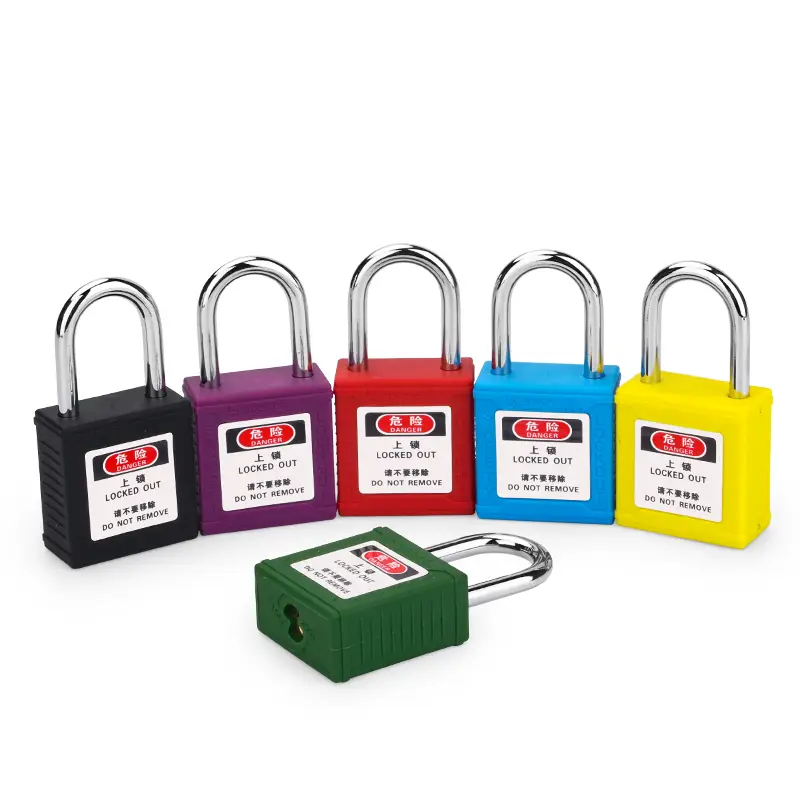
But walk into any industrial supply catalog and you’ll find two main material options: **aluminum** and **nylon** (plastic). Both are OSHA-compliant, both come in high-visibility colors, and both are widely used across manufacturing plants, petrochemical facilities, and automotive plants.
So which one should you buy? The honest answer: **it depends on your environment and the energy source you’re isolating.** Let’s break down the differences.
—
## What a LOTO padlock actually does
Before comparing materials, it’s worth restating the basics. Under OSHA 29 CFR 1910.147, any machine that could unexpectedly start up or release hazardous energy during servicing must be locked out. The padlock is the worker’s personal, keyed device that physically prevents the lockout device (hasp, valve cover, breaker lock) from being removed.
This means a LOTO padlock isn’t just a lock — it’s a **safety-critical component** that must be:
– Strong enough to resist casual removal or tampering
– Visible enough to identify from across the plant floor
– Keyed so only the authorized worker (or a master key holder) can remove it
– Durable enough to survive daily use in the intended environment
Now, how do aluminum and nylon stack up?
—
## Aluminum padlocks: the industrial workhorse
**Best for: petrochemical plants, outdoor facilities, heavy industry, corrosive environments**
Aluminum LOTO padlocks are the most common choice in heavy industry — and for good reason.
**Strength and durability.** An aluminum body with a hardened steel or aluminum shackle can withstand significant abuse: impacts, drops, torque, and attempts at removal. In environments where equipment gets knocked around, aluminum holds up.
**Corrosion resistance.** Aluminum naturally forms a protective oxide layer, making it highly resistant to rust and corrosion. That’s a major advantage outdoors and in humid, salty, or chemical-heavy environments like offshore platforms, refineries, and coastal plants.
**Heat tolerance.** Aluminum handles high temperatures better than plastic. Near ovens, kilns, engines, or steam lines, aluminum padlocks won’t deform or melt.
**Weight trade-off.** Aluminum is heavier than nylon. For daily carry on a tool belt, some workers find this noticeable — though most standard LOTO padlocks are compact enough that it’s rarely a real issue.
**Typical applications:**
– Petrochemical and refinery maintenance
– Outdoor and exposed equipment
– High-temperature processes
– Heavy machinery lockout
—
## Nylon padlocks: the electrical-safe specialist
**Best for: electrical work, clean environments, food and pharmaceutical plants, budget-conscious programs**
Nylon (often glass-reinforced) padlocks are the go-to choice where **electrical safety** is the priority.
**Non-conductive.** This is the big one. Nylon padlocks do not conduct electricity, making them the standard recommendation when workers lock out live electrical panels, switchgear, and other energized equipment. A metal lock near live circuits is an unnecessary risk; nylon eliminates it.
**Chemical and corrosion resistance.** Quality nylon bodies resist many industrial chemicals, solvents, and cleaning agents — including the harsh washdown chemicals used in food processing and pharmaceutical facilities.
**Lightweight.** Nylon padlocks are significantly lighter than aluminum, which workers appreciate for all-day carrying.
**Cost.** Generally, nylon padlocks are more economical, making them attractive for large programs that need dozens — or hundreds — of locks at once.
**Trade-offs.** Nylon isn’t as impact-resistant as aluminum, and it has a lower heat tolerance. Extreme cold can also make some plastics brittle. In rough environments or near high heat, nylon will wear out faster.
**Typical applications:**
– Electrical panel and breaker lockout
– Cleanrooms, food and beverage processing
– Pharmaceutical manufacturing
– Facilities where non-conductive tools are required
—
## Quick comparison table
| Factor | Aluminum | Nylon |
|—|—|—|
| Impact resistance | ⭐⭐⭐⭐⭐ | ⭐⭐⭐ |
| Corrosion resistance | ⭐⭐⭐⭐⭐ | ⭐⭐⭐⭐ |
| Heat tolerance | ⭐⭐⭐⭐⭐ | ⭐⭐⭐ |
| Electrical safety | ⭐⭐ (conductive) | ⭐⭐⭐⭐⭐ (non-conductive) |
| Chemical resistance | ⭐⭐⭐⭐ | ⭐⭐⭐⭐ |
| Weight | Heavier | Lightweight |
| Cost | Higher | More economical |
| Best for | Heavy industry, outdoor, high heat | Electrical work, clean environments |
—
## How to decide: a 3-question checklist
Still unsure? Answer these three questions:
**1. What energy are you isolating?**
Electrical work → nylon (non-conductive). Mechanical, thermal, chemical, or pressurized systems → either, but aluminum adds durability.
**2. What’s the environment like?**
Outdoors, humid, corrosive, high heat, rough handling → aluminum. Cleanrooms, food processing, washdown environments → nylon.
**3. What’s your program size and budget?**
Large rollout with tight budget → nylon saves money. Small, long-term program in harsh conditions → aluminum pays off in longevity.
**Mixed facilities should stock both** — many plants keep nylon locks for electrical crews and aluminum for mechanical maintenance. It’s not an either/or decision; it’s a matching decision.
—
## What else your LOTO program needs
A padlock alone doesn’t make a compliant program. Complete your kit with:
– **Safety hasps** — allow multiple workers to lock out one energy source
– **Valve lockouts** — secure gate, ball, and plug valves against operation
– **Cable lockouts** — isolate multiple energy sources at once
– **Circuit breaker lockouts** — prevent breaker re-energization
– **Lockout tags** — communicate who locked out what, and why
– **Lockout stations** — keep devices organized, visible, and accessible
—
## Why choose ZX Safety Products?
Since 2011, ZX Safety Products Co., Ltd. has manufactured industrial lockout/tagout equipment trusted by automotive, petrochemical, and industrial transportation plants worldwide. We offer:
✔ Aluminum and nylon LOTO padlocks in a full range of high-visibility colors
✔ Keyed-alike, keyed-different, and master-key systems
✔ Custom engraving with names, logos, and department IDs
✔ Complete LOTO solutions: hasps, valve locks, cable locks, breaker locks, tags, and stations
✔ OEM/ODM customization for special requirements
Safety isn’t a one-size-fits-all product. It’s a program — and it starts with the right padlock for your specific hazards.
**Ready to upgrade your lockout/tagout program?**
�� Browse our aluminum LOTO padlocks: [https://www.zxsafetylock.com/lockout-tagout/padlocks/aluminum-padlocks/aluminum-loto-padlocks/](https://www.zxsafetylock.com/lockout-tagout/padlocks/aluminum-padlocks/aluminum-loto-padlocks/)
�� New to LOTO? Read our complete padlock guide: [The Complete Guide to Lockout/Tagout Padlocks](https://www.zxsafetylock.com/blog/the-complete-guide-to-lockout-tagout-padlocks-what-every-safety-manager-needs-to-know/)