
Common Issues with Safety Cable Locks
- Avoid exposing the lock to rain
During the entire use of a safety cable lock, do not forget to keep it protected from rain. Exposure to heavy moisture can severely affect its performance. - Daily maintenance is essential
It is important to maintain the safety cable lock every day. Do not allow dirt or debris to enter the anti-theft lock cylinder. If contaminants enter the cylinder, internal blockage may occur, preventing the key from being inserted or the lock from being opened properly, and in severe cases making it impossible to open at all. - Regular lubrication of the lock cylinder
During the use of a safety cable lock, lubricants such as grease, flake graphite, or pen powder must be applied to the lock cylinder in a timely manner. Over long-term use, high-density metal oxide films may form inside the anti-theft cylinder. If this oxidized layer is not lubricated regularly, normal operation of the cable lock will be affected. Therefore, users should keep the lock cylinder adequately lubricated to ensure smooth and safe operation. - Be aware of temperature effects on the lock body and key
Since the lock body and key of a safety cable lock are made of polyester plastic material, heat expansion and cold contraction caused by temperature changes must be considered. Proper coordination between the lock body and key must be maintained to avoid jamming and ensure safe, normal operation of the cable lock.
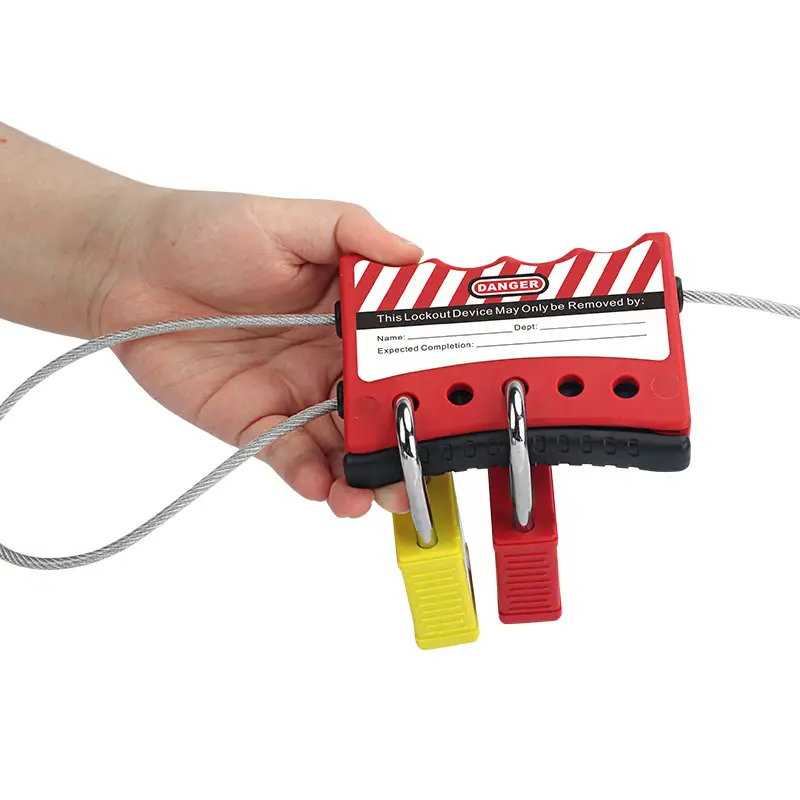
II. The Importance of Safety Cable Locks
Although the concept of safety cable locks was introduced relatively late in some regions, the rapid development of the industry in recent years has greatly promoted the advancement of safety hardware. The types and features of safety cable locks have been gradually refined. As safety awareness improves, market demand for safety cable locks continues to grow.
Safety cable locks are mainly used in industrial environments, where their application is critical to the safety of mechanical equipment and personnel. Traditional industrial machinery and power devices often involve potential hazards, making proper safety protection essential. Safety cable locks help prevent accidental activation or shutdown of equipment within a work area, protecting ongoing industrial operations and preventing severe consequences, including injuries or fatalities.
This is especially important during equipment repair or maintenance. Improper handling of hazardous energy sources can easily cause serious injuries or death to maintenance workers—an incident type with historically high occurrence rates. Safety cable locks effectively address these risks by locking out and clearly labeling hazardous energy sources while warning relevant personnel and preventing safety incidents, thereby ensuring worker protection.
Safety cable locks are indispensable in the industrial field—they ensure personnel safety and provide reliable control over hazardous energy sources.